Do you suffer from Halitosis?
In the 1920s, Listerine faced a problem.
Originally invented in 1879 as a surgical antiseptic and later sold as a mouthwash, sales had stagnated at around $100,000 a year—respectable and established, but far from mass success.
That changed when Listerine launched one of the most influential ad campaigns in marketing history, which impacted not only sales but also society to this day.
“HALITOSIS makes you unpopular”
This is the headline of the ad that showed sad women and rejected men. The reason for their loneliness?
Halitosis—a fancy and medical-sounding word for bad breath.
The term has been used only in clinical contexts before, but the campaign turned it into a national anxiety.
The sales skyrocketed fortyfold within a few years, and the message was clear:
Use our product, or die alone.
The Oldest Marketing Tools: Fear & Hope
The campaign is often cited as a prime example of successful marketing and established a new formula:
Create a fear, name it, offer the cure.
I think it’s a highly questionable example—morally and ethically.
By exploiting insecurity, instilling doubt, and juggling with fundamental fears, it transformed a product into a social necessity.
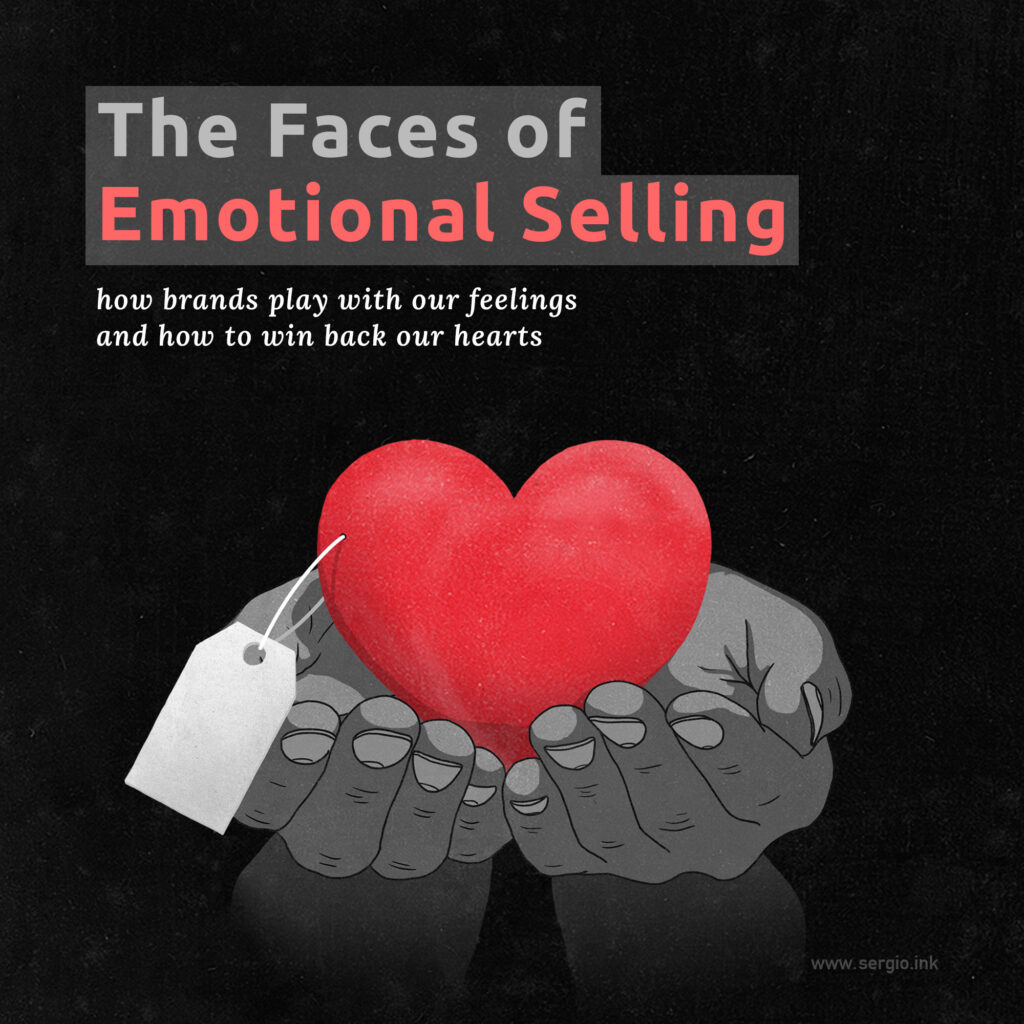
The truth is, emotional selling is not inherently bad or good.
It’s rather a tool—one of the most powerful in marketing, and the biggest brands use it successfully.
The question is how it’s used:
Does it spark smiles or pressure?
Does it support the product’s truth—or faking it?
Does it convince through value—or manipulation?
But what are the different levels? Where is the tipping point?
Let’s dive a bit deeper by looking at the full spectrum.
The Emotional Selling Barometer
🧠 Logic-Based Marketing
Focus: Facts, clarity, product truth.
- “This water filter removes 99.9% of bacteria.”
- “Our car is safer than competitors—tested and certified.”
→ Rational, transparent, and trust-building.
❤️ Heart Zone: Authentic Storytelling
Focus: Genuine emotion, shared values, meaning.
- Dove—”Real Beauty”: inspiring self-acceptance.
- Nike— “Just Do It”: empowering determination.
→ Emotion enhances the truth embodied in the product.
Mostly positive and inspiring. It feels real, not forced.
⚠️ Alert Zone: Persuasive Emotion.
Focus: Urgency, scarcity, belonging pressure.
- “Don’t miss out.”
- “Limited Edition.”
- “Be part of it” (Hypes and trends.)
→ Starting to feel nudged. Subtle marketing.
“Act now, or regret later” vibes.
Initial generosity feels like bait.
When a “free ebook” costs your email address, it feels dishonest.
🖤 Danger Zone: Manipulative emotion
Focus: Fear, guilt, shame, false hope.
- “Believe us, you’re broken—we can fix you.”
- “Miracle cure” promises.
→ An extremely exploitative stage. Truth and best interest for the customer disappear.
Toxic thoughts take root while impossible dreams are sparked.
So-called miracle cures or classic pyramid schemes play with people’s desperation and hope.
Beyond this level, emotion becomes weaponized—like political propaganda with potentially catastrophic consequences.
Win Their Heart First—Then Their Wallets
The road between “This water filter removes 99.9% of bacteria” and “If you love your family, you’ll buy this water filter” is paved with broken promises and lies.
But my point is not to expose or boycott brands, or feel guilty when we buy stuff from time to time just to feel good.
What I plead for is awareness and becoming more conscious consumers, like hiring bouncers for our minds.
We decide what enters—we are in control.
Let’s be highly attentive so we can spot the moment when an emotion, instead of a function, is sold or pressure is built.
Let’s develop the habit of asking ourselves, “Am I buying a product or an emotion?”
Whatever the answer and whatever the decision after that
—we decided.
Why is heightened awareness more important than ever today?
And why it alone won’t save us?
Because…
The Ultimate Distraction Endboss is on the Rise
Emotional selling has always influenced our shopping behaviour.
But now it’s powered by algorithms, clickbait, and AI.
And let’s be honest—these systems can pinpoint our unique emotional triggers far better and with scientific precision than an agency in the 18th century.
Our hearts are constantly in the crosshairs.
An inner alert system won’t cut it.
We need an antidote.
And this lies in the opposite of consumption.
Create or be Consumed
The creative act is that antidote.
When we make things that truly matter to us—writing, cooking, building—we shift from consumption to creation.
Let’s replace hunting external dopamine spikes with finding purpose and treasures through internal discovery.
That’s the place where we become immune to any noise, just like a child is deeply immersed in play— it’s hard to make it come to the table for dinner.
Rediscovering that childlike state should be our goal.
Final Thought: A Shift of Power
And doesn’t it feel weird?
While the world’s most urgent topic is the threat of climate change, we seem to be at the peak of a throwaway culture.
“Shopping like a billionaire!” mindset takes over as if the gamification of the shopping experience, ridiculously low prices, and the free shipping of things we don’t need across the globe were a kind of liberation.
And while our phone works perfectly well, we stand in line overnight to get the new “red” one with trillions of megapixels more.
Even though it doesn’t feel like it:
We hold the power.
Every single conscious choice shifts the power to us—away from manipulation back to meaning.
From companies to people.
From persuasion to purpose.
Bottom Line
There is a void in each of us that craves purpose—if we don’t fill it with our inner content and creations, others will fill it with theirs.
Fulfillment begins with action — not consumption.
Because once you’ve tasted the dopamine kick sparked through building something meaningful, you have no reason to come back to the noise.
And that is when focus and flow become the purest form of freedom.