The Ideal Client’s Brief

There are three types of briefings:
The Good, the Bad, and the Ugly.

The Good

When limitations unleash creative freedom.

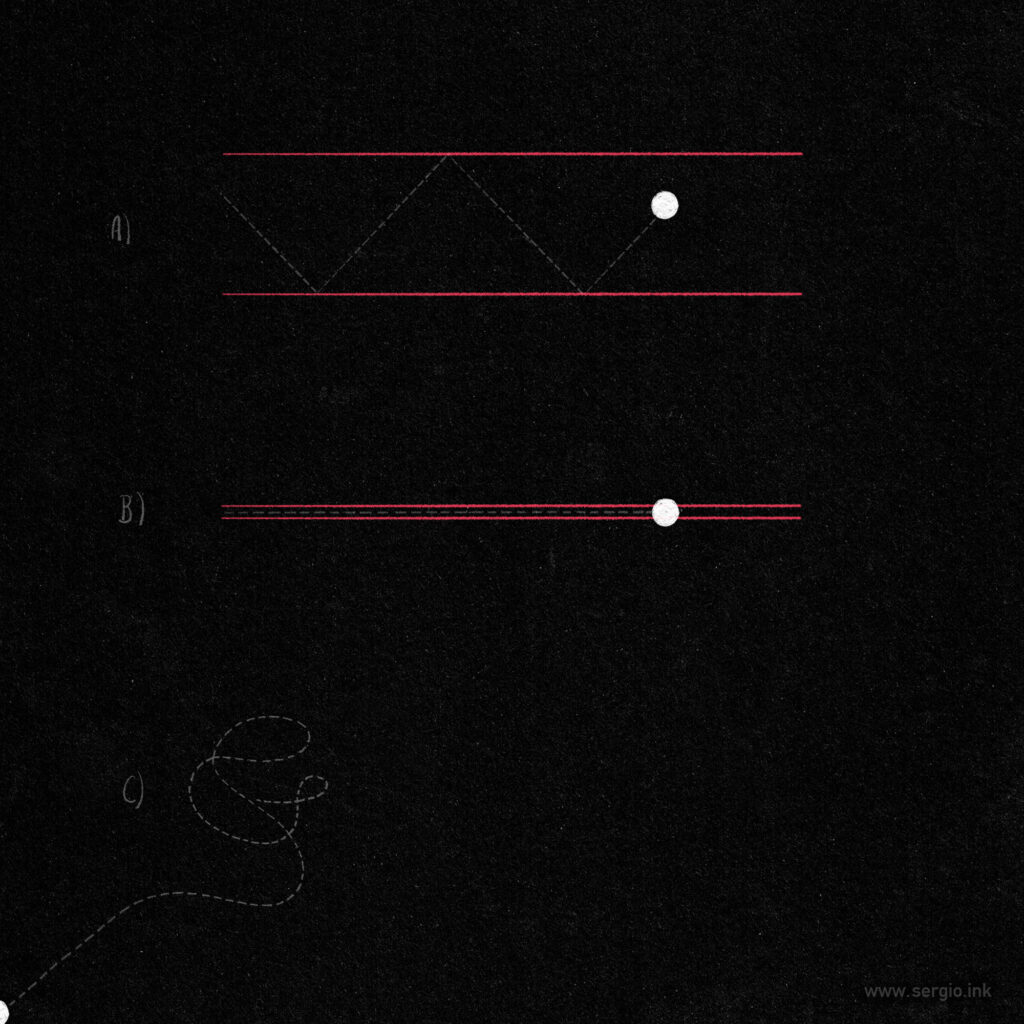
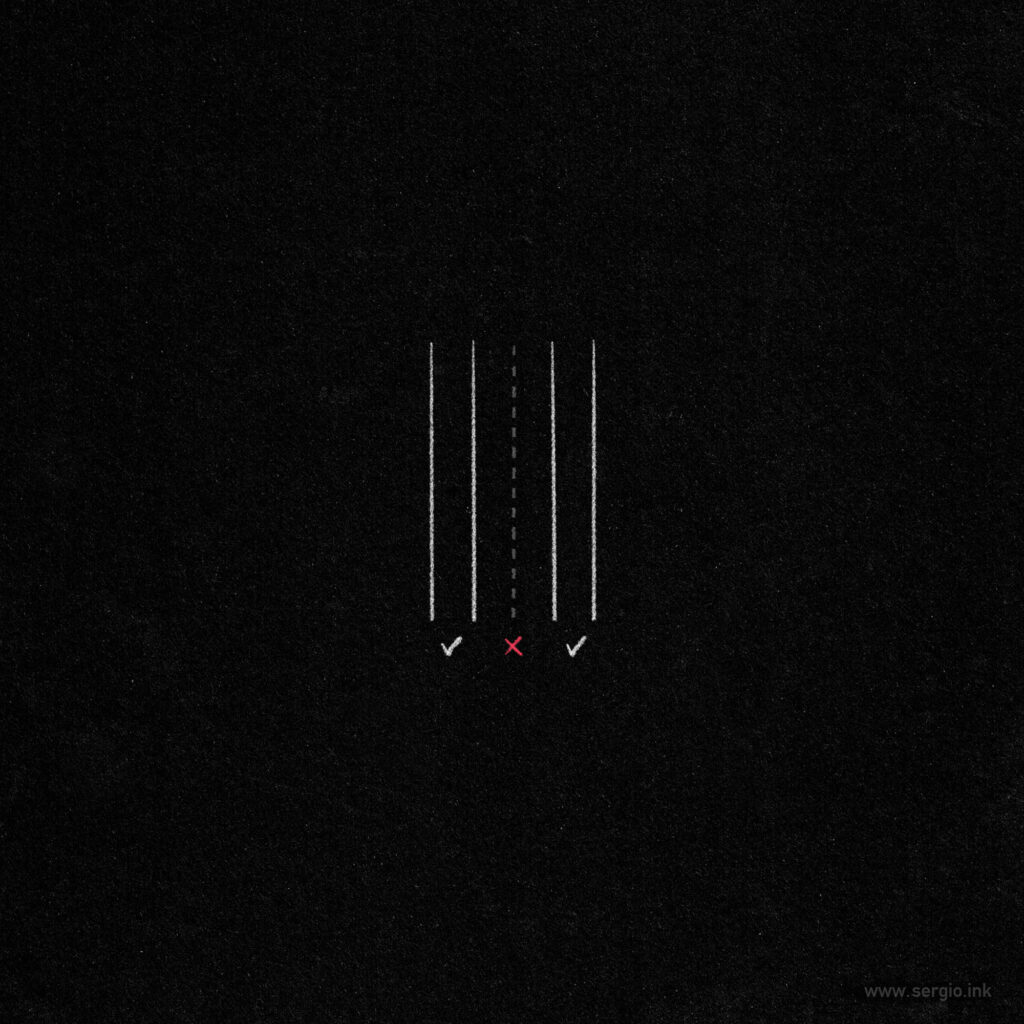
The ideal client’s brief feels like a guardrail. It always keeps the creator heading towards the right direction while leaving enough space to switch lanes and try alternate approaches.

It’s the perfect mix of creative freedom and joint goal alignment.

One of the most idea-sparking projects I had as an illustrator was the creation of a movie key art. The briefing was super clear in terms of aesthetics and the key elements, while it outlined three specific approaches I could explore visually. Just the right amount of limitation and impulses to generate dozens of ideas without losing myself in the process.

The Bad

When too-tight reins eliminate passion and potential.

A too-narrow briefing feels like moving on tracks. There’s no space for serendipity, alternate perspectives, or novelty—in short, there is zero risk involved.

It’s hard to explore the unknown on already paved roads.

This approach of apparently “playing it safe” reduces positive tension and excitement within the process—an ultimate novelty-killing mindset.

Usually, in these rigid collaborations, everyone involved just seems to look forward to arriving instead of moving.

The Ugly

When absence of guidance becomes a creative nightmare.

The worst briefing sounds like this: “You have absolute creative freedom.” It’s like leaving someone in the desert without a map or compass and asking them to find the oasis.

This might be ok for open-ended, budget-free collaborations, but the moment money and time pressure are involved, chaos is inevitable.

It’s not a sign of trust or confidence —it’s negligent.

A collaboration that agrees on this sole rule is based on laziness from both sides—the client and the creator. Providing services naturally comes with expectations on both sides.

If there are no expectations articulated, how do we ever know we meet them? And how could we ever quote that?

Bottom Line

The creative mind is a pro at building missing puzzle pieces.

But it needs to know in which picture it should be implemented in the end.

If the briefing is not good at the moment, try to make it through honest communication.

If you manage to set the guardrails and the goal together—great.

If not, say thank you for the request and decline.

The Blank Page

The blank page is never empty—it’s filled with doubts and fears.

You are not alone.

The fear of the blank page is real. Anyone who has ever tried to manifest their inner world—ideas, visions, perspectives—knows it does exist.

But where does it come from? Why is it so mighty that it can hinder so many ideas from blooming and enriching the world?

Because every imagination carries expectation.

The moment we bring it on paper, we start comparing our creation with that internal image or with other people’s work.

We expect it to look alike—and that’s a battle we can’t win.

To beat the blank page, we must learn to meet our expectations with kindness and flexibility.

Because…

The Truth is

The image on paper will never overlap exactly with the one in our mind.

Never.

That’s not failure. That’s the game.

And we can choose to enjoy it—despite waves of frustration and anxiety during the whole process.

Let go of expectations, and flow will follow.

Here are Three Quick Tips to Start

  1. Keep the ink moving
    Whether you want to write or sketch something—just hit the canvas. Describe your current feelings or draw random doodles. It’s like a warm-up session before pushing the weights.
  2. Crumble perfection
    Sometimes the flawlessness of a clean page, a new sketchbook, or notepads can intimidate the beginning. Break the perfection by tearing off a corner of the paper or crumpling it. Process is always messy and has no space for order.
  3. ”Dance with the fear”
    It’s one of my favorite messages from Seth Godin. Accept that the fear will never go away. It’s part of the process, and all we can do is embrace and dance with it.

Start ugly. But start.

The Power of Action

There is only one way to create:
take action.

The journey of a creative mind is paved with obstacles and enemies that try to stop us from drawing the first line of a painting, writing the first sentence of a novel, or sketching out an innovative product we have in mind.

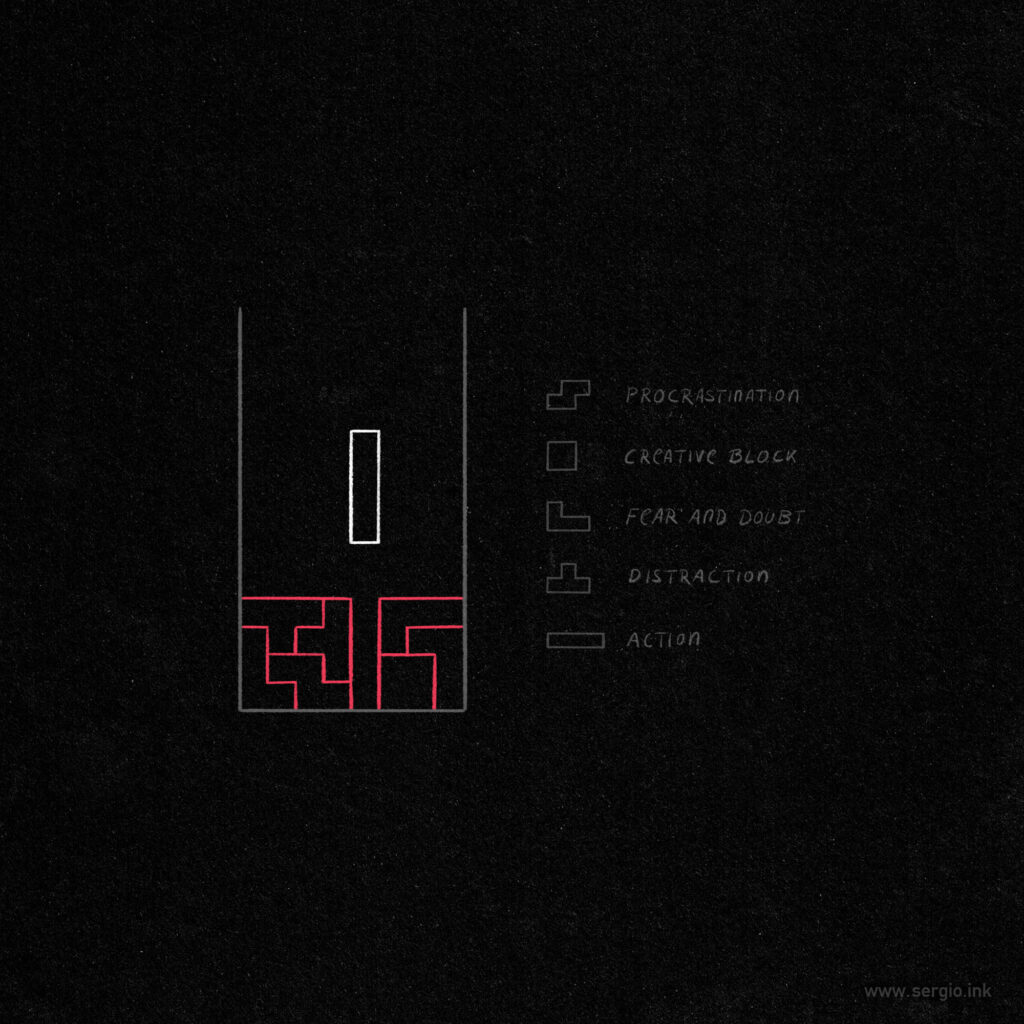
So many great ideas never saw the light of day because of these enemies. And they have names: procrastination, imposter syndrome, creative block—all part of a bigger monstrosity called resistance.

“Resistance is like the Alien or the Terminator or the shark in Jaws. It cannot be reasoned with.”
—Steven Pressfield
(The War of Art)

After living a creative life for more than two decades, I have one bad news and three good news.

The Bad News

These wicked creatures do exist, and most of them will never vanish completely.

The Good News

  1. They are nothing but holograms of our doubts and fears. They are mainly are the fear of not meeting expectations—whether our own or others.
  2. We can reinterpret them by using them as a signpost or compass. Whenever resistance strikes, it’s a sign that we are on to something important to us and worth fighting for.
  3. They serve as a natural selection between those who start and those who don’t. If you can beat them, your chances of creating impact are high.

Don’t just accept their presence—embrace it. Use it. They are part of the creative adventure and seeds of growth. Train yourself to face them in eager anticipation.

Trying to dodge them would be like playing Super Mario or Zelda in a world without enemies—no fun at all.

And again, there is one single solution to beat them all: take action.

You’ll see that most of these enemies crumble the moment the pen tip hits the canvas.

And the best part is: the effort can be incredibly small.

Whenever I receive a new commission for an illustration project, I feel their presence. Procrastination will immediately try to convince me that cleaning the dishes is suddenly the most important thing.

Bottom Line

Creative enemies will never go away—but you decide how to treat them.

Don’t allow them to breathe.

Next time you feel stuck, just do something—no matter how small. Create a folder structure on your computer. Draw the first sketch in seconds. Jot down your immediate thoughts.

The moment you make, you are already in the middle of the process.

Availability: Service Provider vs Expert

Sometimes I’m hired for my service. Sometimes for my expertise.

Here’s the difference:

Service Provider

When we offer services, we don’t just get paid by our clients for our work and solutions to their problems.

We are mainly getting paid for reliability. In a competitive market, this is our most important selling point.

Providing a service demands a certain level of availability and flexibility—these are parts of reliability.

No masterpiece serves the client if it’s not delivered on time, and if the client feels that they cannot rely on us, we will be replaced sooner or later.

When I started offering my illustration service, I was aware that ad agencies work fast and on short notice and that magazines have strict deadlines. These are mostly non-negotiable conditions.

It’s my job to align my schedule around the client’s schedule. Not the other way around.

Accepting these conditions is not only mandatory. More than that, we have to find joy in meeting expectations. Making collaboration as smooth and pleasant as possible for all parties should be taken as a personal matter.

Expert

Things change as soon as we get hired as super-specific experts.

We’ll become these experts when we invest significantly more time and effort in a chosen subject than others. We gain a unique perspective through experiences and knowledge.

Experts are hardly outperformed by the competition. Someone who is easily replaceable is most likely not an expert.

When I am invited by companies and universities to give talks and share my experience about creativity or how to establish a freelance business, for instance, I am not the service provider anymore. Then, I’m the expert.

The expert is treated and compensated differently because the expert provides unique and precious knowledge in a specific field.

The expert is asked for availability because expertise will always be demanded and appreciated in any field.