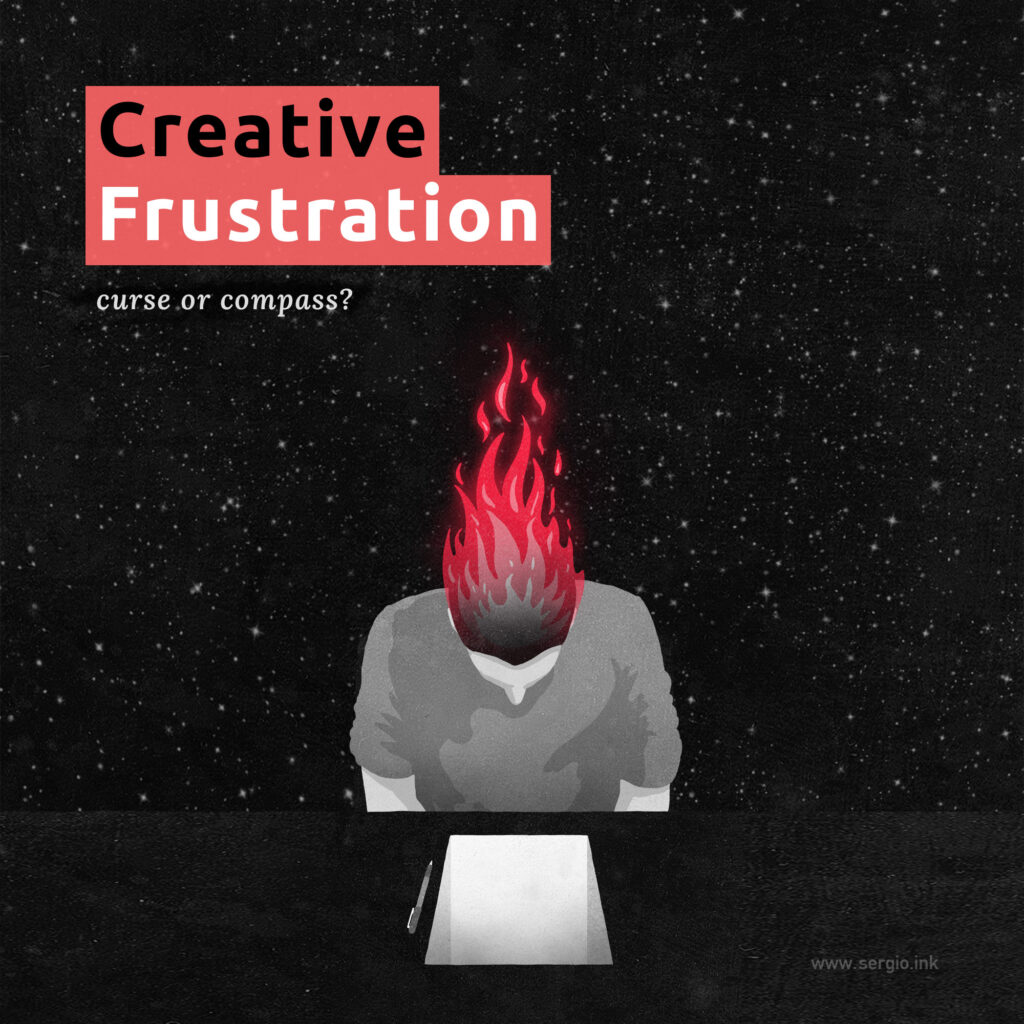
The joy of the creative act always comes with hot waves of frustration—even desperation.
If you have ever tried to paint like your favorite artist, play your favorite song on the guitar, or attempt to cook Mom’s perfect risotto, you know that boiling emotion in your chest when things don’t turn out as imagined.
Our brain is a master at visualizing ideal results.
Like when we book a hotel—we instantly picture the view, the light, the smell—and often, because of our irrational expectations, we’re disappointed upon arrival.
The same happens with creativity.
Our imagination is usually far ahead of our skills—and developing them takes patience and practice.
That’s the expectation gap—or, as radio producer Ira Glass called it, The Taste Gap—the space between our ability to envision something extraordinary and our current ability to manifest it.
So, just because we’ve read every book by our favorite author doesn’t mean we can write like them.
The Dilemma of Inspiration
Consuming the work and art we admire is a double-edged sword:
it can motivate us to start creating and intimidate us before the brush even touches the canvas.
It can spark passion and pressure at the same time.
Sounds like a prime example of a toxic relationship, don’t you think?
What can we do to fix it?
3 Steps to Recalibrate Frustration
Step 1 — Acknowledge Frustration
Realize that frustration isn’t your unique suffering. It’s part of the deal—a rule of the creative game.
Every artist, designer, or entrepreneur knows it’s there—lurking behind every corner that leads to innovation and quality.
Realizing it will never truly vanish is a good start.
Step 2 — Reinterpret Frustration
Okay, we can’t get rid of it. So let’s look at it through a different lens.
What if frustration is benevolent?
What if it’s the universe’s way of asking us:
How serious are you about this?
Do you care enough, or is it just a temporary euphoria?
Frustration isn’t a wall—it’s a stress test for your desire.
Nobody is spared from it.
The question is only how we face it when it shows up.
Do we fall off at the first headwind, like many?
Or will we push through, growing stronger and coming out wiser on the other side?
Step 3 — Use it
If we start seeing it as a hint of meaning and direction, frustration can actually become a compass.
Think about it:
What does the presence of frustration actually tell us?
Could it mean that we’re on to something important?
Something that we care deeply enough to endure the heat?
Something meaningful that is worth suffering for?
Let’s treat it as a lighthouse — a signal of relevance in an era of shallow noise.
“Creative Routine” is a Paradox
Real excitement, challenge, and growth await us in new territories.
And the unfamiliar is always intense.
The goal of a creative mind isn’t to avoid the heat, but to seek and to embrace it.
Harness its energy to get on the right track.
Bottom Line
Frustration isn’t the enemy.
It’s our creative companion,
our dance partner,
and our navigator
on the odyssey toward a life full of meaning and adventure.
Facing it again and again builds persistence—and a creative confidence that strengthens every other part of life.