I’ve changed my mind about AI.
A few months ago, I read the statement: “AI is eating the world.”
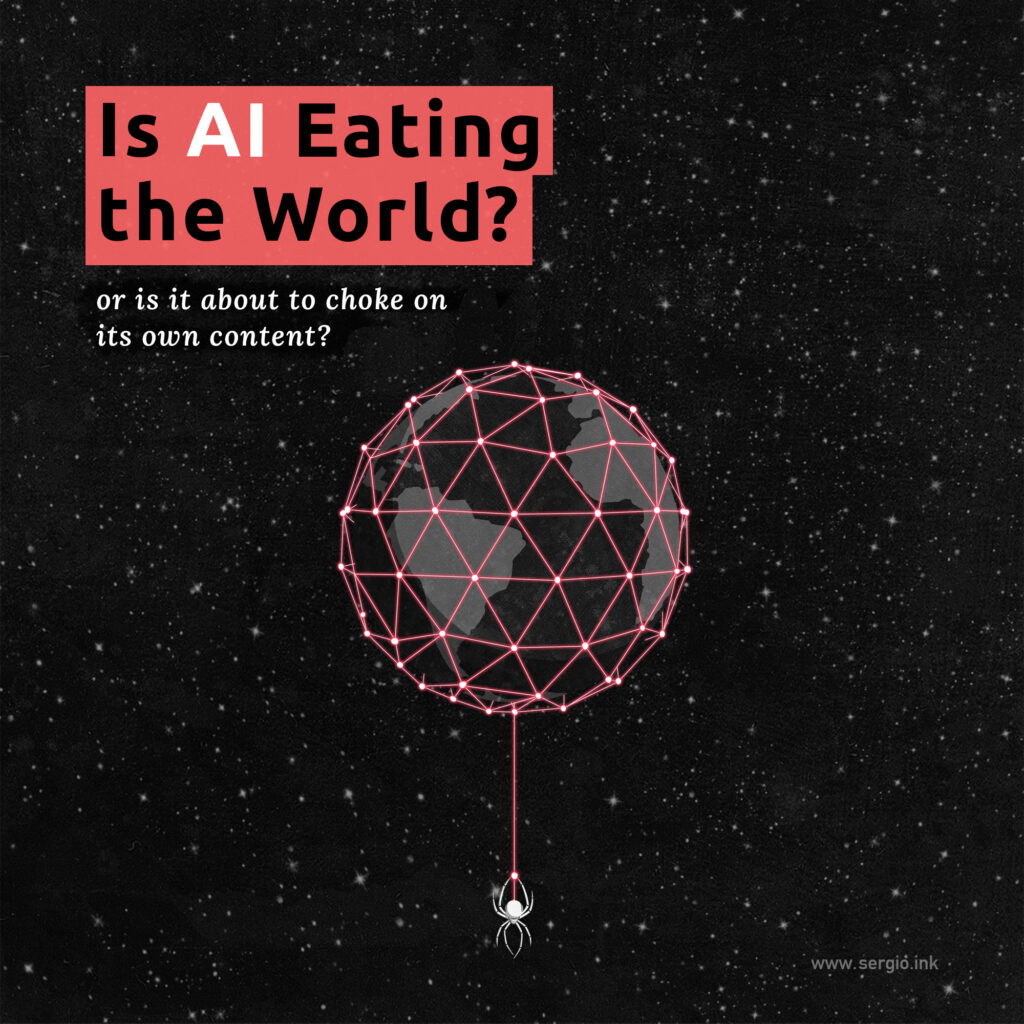
Immediately, I had this image in my head—a robotic spider weaving a web around its prey, our world as we know it.
I don’t know why it popped up so quickly. Maybe because I was outside with my son that day, searching for insects. Maybe because of my lifelong fascination with spiders, which started with my first horror movie, Tarantula.
However, the real question I asked myself was:
Do I actually agree with this statement?
Short answer: no.
But something in me has changed. When the first AI tools came out, I was hooked and impressed—especially when I saw the first AI-generated visuals.
Intimidation and aversion would be the right words to describe my first reaction. Ethically irritated and personally threatened, I immediately pictured what this could mean for me as an illustrator.
Learning to Spot the Trick
I calmed myself quickly. I told myself: our eyes aren’t used to this level of imitation yet. AI is like the old 1950s “rolling road” film trick, where the reel made a static car look like it was driving. Back then, it felt real. Today, our eyes instantly spot the trick.
The same might be true for AI content, I thought. We just need time to develop the ability to see cracks in the illusion.
And it feels like we already do. People start to recognize patterns in texts and emails because they feel “ChatGPT-like.” Or we notice the odd mimicry in lips and eyes in AI videos.
Those thoughts relieved me a bit.
But now?
Learning to Spot the Trick
I calmed myself quickly. I told myself: our eyes aren’t used to this level of imitation yet. AI is like the old 1950s “rolling road” film trick, where the reel made a static car look like it was driving. Back then, it felt real. Today, our eyes instantly spot the trick.
Outpacing Our Senses
I have to admit that the latest evolution of AI surpasses our ability to spot those reality cracks at the speed of light.
Like most of us, I feel this leap in technology will change everything—our daily lives as well as the whole concept we call “work.”
We, as a society, can try to regulate and control it through restrictions and laws. But it will come over us like a tsunami of opportunities and threats. And when it crashes, maybe the best way to survive is to ride it.
Or… maybe not.
A Brighter Door?
Maybe a new door opens right now—one that leads to another, even more challenging yet brighter future.
What if AI is the final nail in the coffin of the attention economy—an omnipresent, life-soaking, boredom-extinguishing, eyeball-pulling era of distraction?
What if catchy thumbnails, algorithm-driven kitty cat videos, and clickbait headlines finally lose their last currency—authenticity?
Maybe it’s the turning point where content starts to cannibalize itself.
Maybe infinite generation overstretches the attention span of our civilization.
And maybe this will finally lead us to turn our backs on:
fake perfection,
fake happiness,
fake success,
fake authenticity.
And to start shifting our attention back to something truly meaningful—beyond screens.
A The Simpsons Scene of Hope
Maybe because of this silver lining, I can’t stop thinking about a specific Simpsons scene: the kids of Springfield switch off their TVs after the cartoons lose their edge. One by one, they step outside, blinking against the sun as if waking from a long sleep. And then something beautiful happens: they play. Running, laughing, skateboarding. No screens, no noise—just children rediscovering life in the street.
Maybe that’s what is happening now.
Reawaken our childlike curiosity.
Switch passivity for activity.
Move from doomscrolling to mindscrolling.
Prioritize creation over consumption.
Fulfillment Can’t Be Consumed
Let’s be honest—we all reached the point where we feel full. Sick of content and consuming. Like after an exaggerated fast food session.
Fulfillment, on the other hand, can’t be consumed. It must be discovered.
AI may come close to perfect imitation. But perfection is exactly its Achilles heel. Being human means being imperfect. That’s when we connect. And our chance to become a leading voice in this noise through honest, true, vulnerable, and generous acts of creating and sharing has never been higher.
It takes courage. But do we really have a choice?
Goodbye, My Love
And to start with myself: I have to admit I used to hide behind my illustrations, like my Mindshots series. Why reveal more about myself than necessary, I thought? Why expose myself to potential attacks and criticism?
AI has forced me to reconsider, as illustration—the love of my professional life—is about to break up with me.
And yet, I don’t feel scared in the age of AI and its uncertainty. Because by sharing my uncensored view with you—whoever and wherever you are—already feels like a human connection.
That’s the one thing AI can’t replace… at least for today.
Bottom Line
Let’s start searching for the best dopamine spikes in life—the ones no screen can spark.
Now is the time to explore our inner world and unlock our creative potential through action.
And AI?
Let’s use it to facilitate the creative act—not to replace it with more reels and posts.
Take this essay I’m writing right now.
Are these my genuine thoughts on a random Wednesday morning while sitting in my favorite café?
Yes, 100%
Will I use ChatGPT to refine the words, so they reach you more clearly?
Yes, I will.
Does that make me a hypocrite?
I don’t know yet.
All I know is: I believe in a healthy coexistence of creativity and technology that will boost us into a bright future.
And it’s up to us to make this reality.