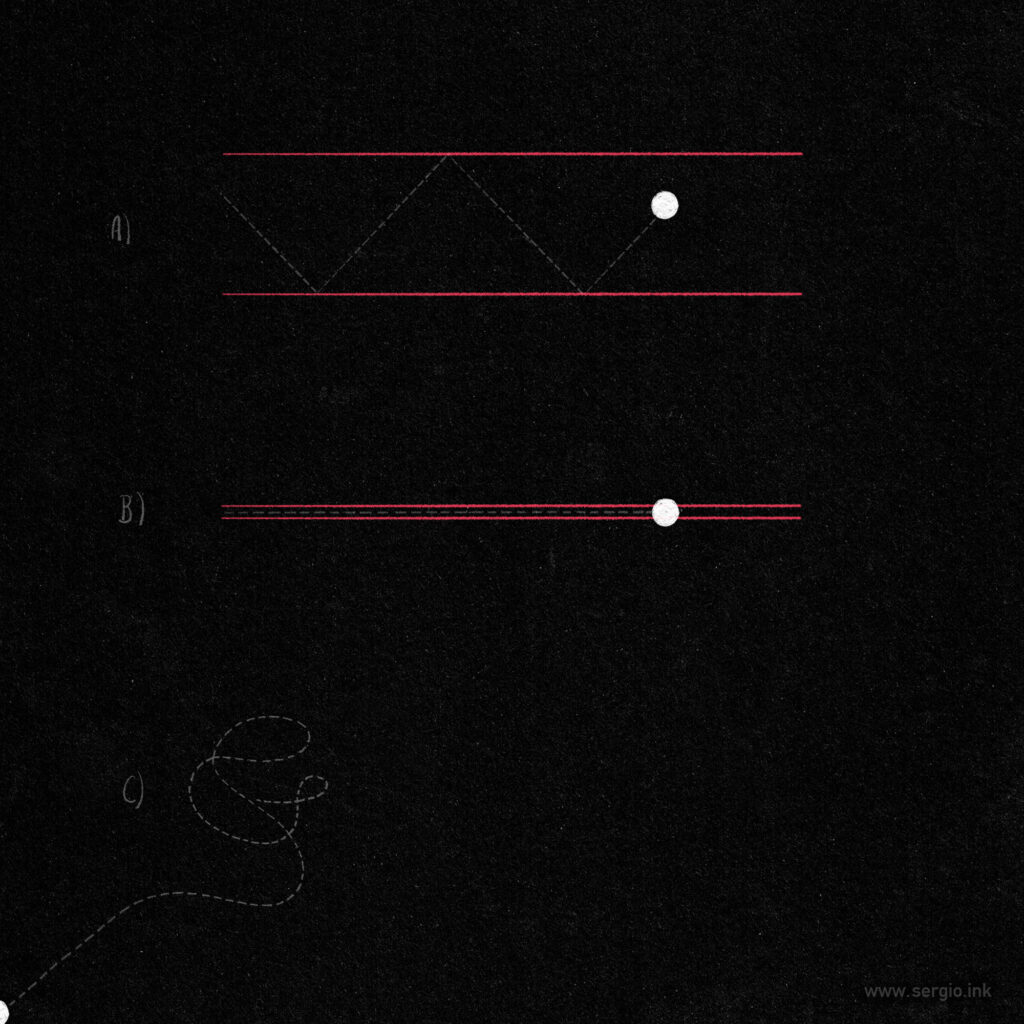
There are three types of briefings:
The Good, the Bad, and the Ugly.
The Good
When limitations unleash creative freedom.
The ideal client’s brief feels like a guardrail. It always keeps the creator heading towards the right direction while leaving enough space to switch lanes and try alternate approaches.
It’s the perfect mix of creative freedom and joint goal alignment.
One of the most idea-sparking projects I had as an illustrator was the creation of a movie key art. The briefing was super clear in terms of aesthetics and the key elements, while it outlined three specific approaches I could explore visually. Just the right amount of limitation and impulses to generate dozens of ideas without losing myself in the process.
The Bad
When too-tight reins eliminate passion and potential.
A too-narrow briefing feels like moving on tracks. There’s no space for serendipity, alternate perspectives, or novelty—in short, there is zero risk involved.
It’s hard to explore the unknown on already paved roads.
This approach of apparently “playing it safe” reduces positive tension and excitement within the process—an ultimate novelty-killing mindset.
Usually, in these rigid collaborations, everyone involved just seems to look forward to arriving instead of moving.
The Ugly
When absence of guidance becomes a creative nightmare.
The worst briefing sounds like this: “You have absolute creative freedom.” It’s like leaving someone in the desert without a map or compass and asking them to find the oasis.
This might be ok for open-ended, budget-free collaborations, but the moment money and time pressure are involved, chaos is inevitable.
It’s not a sign of trust or confidence —it’s negligent.
A collaboration that agrees on this sole rule is based on laziness from both sides—the client and the creator. Providing services naturally comes with expectations on both sides.
If there are no expectations articulated, how do we ever know we meet them? And how could we ever quote that?
Bottom Line
The creative mind is a pro at building missing puzzle pieces.
But it needs to know in which picture it should be implemented in the end.
If the briefing is not good at the moment, try to make it through honest communication.
If you manage to set the guardrails and the goal together—great.
If not, say thank you for the request and decline.