In 2011, I visited a design conference in Singapore.
Leading creatives and artists were sharing their works, stories, and wisdom.
At that time, I was working on my final thesis. It was also a time when I felt completely lost.
I couldn’t think of what to do after my studies.
Should I go back to my job as a fashion graphic designer?
Should I apply to an ad agency?
Apply to an ad agency?
No way felt right.
The Advice I Needed
So, when the host asked the creative consultant Yang Yeo for one piece of advice, I listened very carefully.
“Do what you love—the money will follow,” he said.
I carried this advice for the rest of my trip to Beijing.
While visiting designers and artists along the way for my thesis, I constantly asked myself what I really love to do.
And when I sat on the plane back home, with a backpack full of reference material, ten thousand pictures, and precious insights from the interviews, I knew exactly what I wanted to do:
Freelance illustration.
Making a living with my drawings was always an unattainable dream—I never truly believed I would ever achieve it.
That’s why deciding to start my own business felt like a huge leap.
The road was bumpy, but the advice remained and became my compass, my decision-filter—my roadmap to my dream.
And It Worked
Back home, the goal was set, and I worked on it until inquiries came in—a dream come true.
The advice echoed for years—and it worked.
But years later, I came across another quote by Seth Godin:
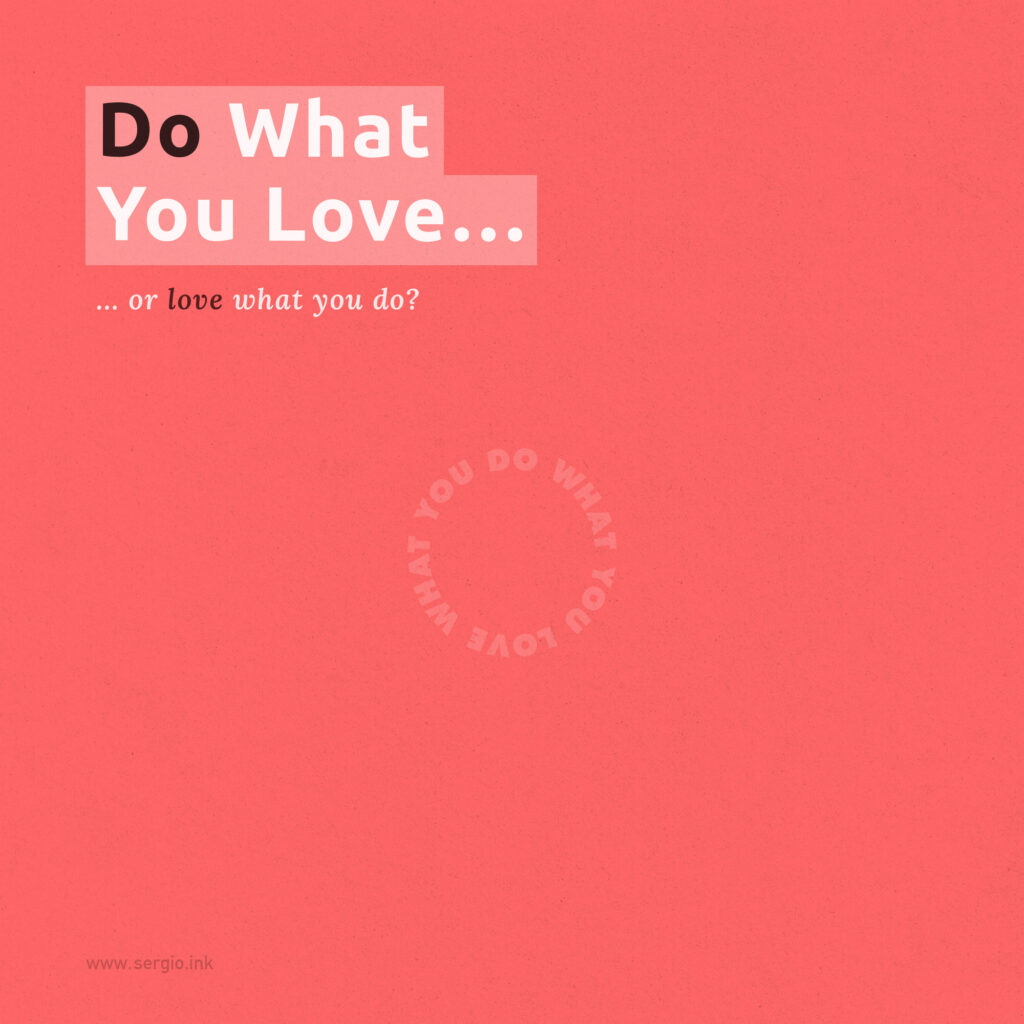
“Doing what you love is for amateurs. Love what you do is the mantra for professionals.”
At first, it sounded like a contradiction. But over time, I began to feel these words as well.
- Passion is good, but it’s not a guarantee to get paid.
- We can’t afford to wait for flow—we need to create it
- Commitment is key—not inspiration
- Love is discovered through actually doing the work.
Every Big Dream Consists of Small Nightmares
—and it’s on us to embrace them all.
It’s about the importance of making a conscious decision—not a choice based on a whim or euphoria.
The vision must have the strength to carry its own weight.
Becoming an astronaut can be such a dream.
But is it strong enough to withstand the math tests, the Russian lessons, the physical exhaustion, and the daily reminder that only a handful will ever make it there?
Becoming a football star is a dream for millions.
But is it strong enough to face being sold overnight, tearing your kids from their friends, losing privacy, moving from city to city, and enduring the headlines that judge you after one bad game?
My dream of becoming a freelance illustrator was strong enough to overcome hurtful criticisms and rejections, an incredible amount of administrative work, panic-sparking last-minute changes, endless nightshifts, and financial insecurities.
There were dozens of good reasons to be afraid.
Recalibrating Nightmares
But the moment I realized that they were steps towards my dream, they weren’t insurmountable problems, or haunting to-dos.
They became what I call mission-tasks.
Instead of dodging them—and here comes Seth’s point—I started to love and embrace them.
Because I knew they weren’t obstacles—they were steps.
Before the decision, the mere thought of talking in English in front of CEO’s, or negotiating and discussing my work with teams of brands that I only knew from TV would have been terrifying.
But if it leads me to a commission to illustrate a movie poster or players of my favorite football team? I can’t wait to jump into the call.
Bottom Line
Every dream must be strong enough to carry its own weight.
The earlier we accept that, the more we can focus on the crucial question:
Are we willing to love what we do in order to keep doing what we love?