
I’ve been working as a freelance illustrator from my home office for over 10 years. Here are 9 essential things and tips that I think make life easier as a freelancer:
Continue reading “9 basics & tips for freelancers”a space to think together—on creativity, attention, and work that matters.
I’ve been working as a freelance illustrator from my home office for over 10 years. Here are 9 essential things and tips that I think make life easier as a freelancer:
Continue reading “9 basics & tips for freelancers”For freelancers and self-employed people, “no” is a powerful tool, like the computer, the Internet, Excel, Photoshop, pen, and paper. We use it, for example, when we don’t feel comfortable with a project request or when we’re negotiating prices.
Over time, we become more confident in using “no” because we can justify it with our experience. We learn to use it at the right time and realize that it does not imply any personal valuation, neither when we say it nor when we receive it.
We see it as an adjustment, similar to when someone on the street asks us if he is on the right way to the train station. If he is going in the wrong direction, we reply “No” and show him the right way. An honest “No” is precious for all sides. Let’s use it.
Our portfolio should only present the works that we like to repeat. Especially as beginners, we tend to show everything we have created. We should definitely resist this. Especially if the response to one of our works was strikingly positive, but we felt little ambition and passion about the work itself. Being good at something does not obligate us to do it for life.
Goethe says, “I can’t get rid of the spirits I called.” If we are not careful, we find ourselves doing years of work that do not fulfill us. Our hands may do it well, but our heart longs for something else. This will not make us happy.
I’ve been writing about creativity, freelancing, and illustration daily for over four months. Last Wednesday was a jam-packed day, and started to write around 11:30pm. I was tired and didn’t know what to write about at all.
The motivation was low. I almost broke the streak and just went to bed. Then I saw that the laptop battery was showing 7%. I decided not to plug in the charging cable. The time to write something was thus limited, and so now all decisions fell quickly. In the end, I wrote two sentences beside the headline. But that was perfectly fine, and I got to bed before midnight.
Without the time pressure, I probably would have worked on the post for a long time, or maybe I wouldn’t have written it. Instead of adjusting the situation to our needs, we can try to adapt to it ourselves now and then.
Waiting for inspiration is not enough. We have to get it, work for it. From my experience, it only comes in the making and playing. Not necessarily at that exact moment, but when we switch our minds into discovery mode.
This happens as soon as we try to physically capture our idea. For example, when an advertiser scribbles his first ideas for a campaign on a napkin, a screenwriter writes down the plot for the first time, or a children’s book illustrator draws his first sketch of the character in his sketchbook.
Once we break through that initial barrier, we start to see things that we can relate to our project or story anytime, anywhere. We put out our feelers, and we pick only the best from what the world has to offer us.
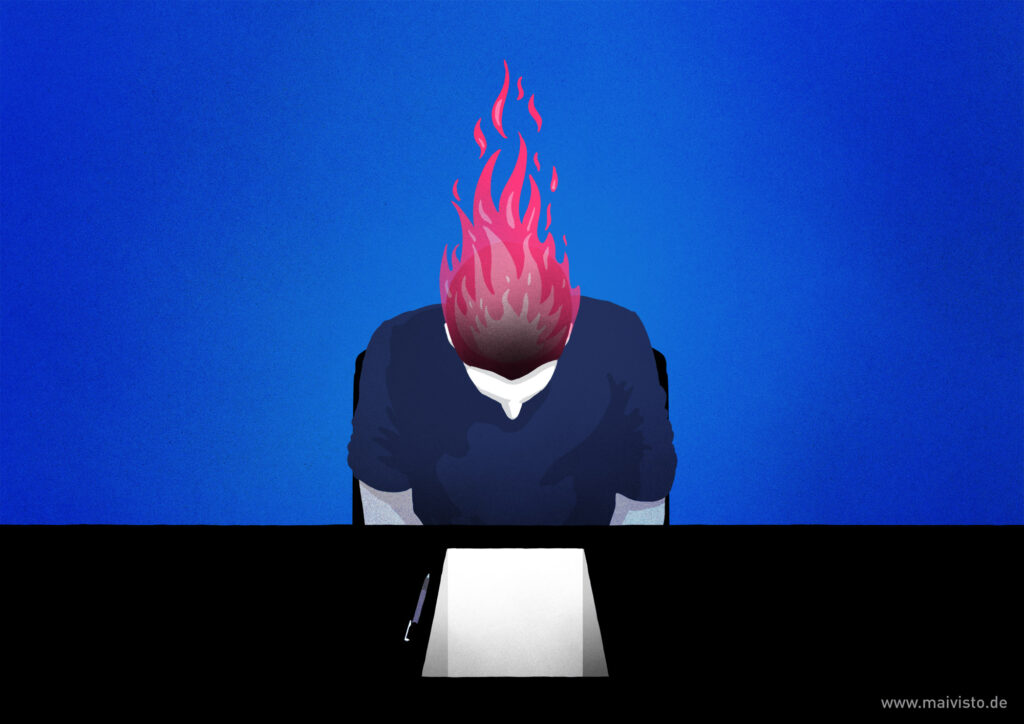
Frustration is usually perceived as something negative. In a way, it is. Who likes that uncomfortable burning feeling behind the chest when the drawing, the layout, or the story doesn’t look like we imagined it. In our minds, it looked already finished, so simple to accomplish.
Continue reading “Let’s embrace frustration in the creative process. It will strike us anyway”When I decided to go the freelance illustrator route, I quickly noticed the differences between permanent employment. We usually have a commute in a permanent position that we do every morning and after work. This one we can find annoying and a waste of time. But the commute home has a valuable advantage. It makes a clear cut between our work and our free time, which helps us structure our daily lives.
As freelancers, this physical cut is often missing. Often, the place where we work and create is the same place where we eat, watch movies, and go to sleep. As a result, we quickly tend to lose track of time and merge our free time with our work time. In short, we lose piece by piece our life outside work. In the times of Covid, many permanent employees are in home offices, so they have experienced the same thing.
There are simple methods to create physical cuts if we can’t or don’t want to go to an external place, such as a co-working space. A fundamentally important one is to dress for work as if we are going to the office. Maybe not in a suit and patent leather shoes, but not in sweatpants or pajamas. This daily routine affects our attitude during work hours. Then, after work is done, slipping into sweatpants is not only a signal to us that we can leave work behind for the day. It can also feel good and earned, and there’s nothing to stop us from enjoying it.
There’s no right or wrong with sketchbooks, no rules, no restrictions. It’s all about us – and that’s the hard part.
Creative meetings, where participants brainstorm or play ping-pong with their thoughts, are an effective way to come up with original ideas.
I believe that creative thinking in a group is ideal for starting and finishing a new project. However, in my experience, the real magic happens in silence when there are no external stimuli like voices, music, time pressure, Instagram, emails, or phone calls
“Your instinct, your human personal intuition always whispers. It never shouts.”
Steven Spielberg
The first step is the most important, they say. But why is that so?
We have managed to conquer the first stage of resistance, for one thing. This can take a lot of strength, overcoming, and a lot of time in the worst case.
The best part is that the first step can be minimal. The first sketch of an idea for a new advertising campaign, the first sentence of our novel, or the first Google search on our bachelor thesis.
The first step may take a few moments, but what happens to us at that moment changes everything. Because the moment we start, we put on a pair of glasses. More precisely, we look through a template or filter from now on. We switch our minds into discovery mode.
Suddenly, whether consciously or subconsciously, we begin to perceive things around us differently related to our project. Similar to the phenomenon that if we bought a red jeep, we now start seeing red jeeps everywhere on the roads. They were always there, but now we see them first.
Our subconscious works from now on, even when we do something completely different, like the household. The well-known brilliant idea that struck us in the shower is not creativity. It is only the result of creativity.
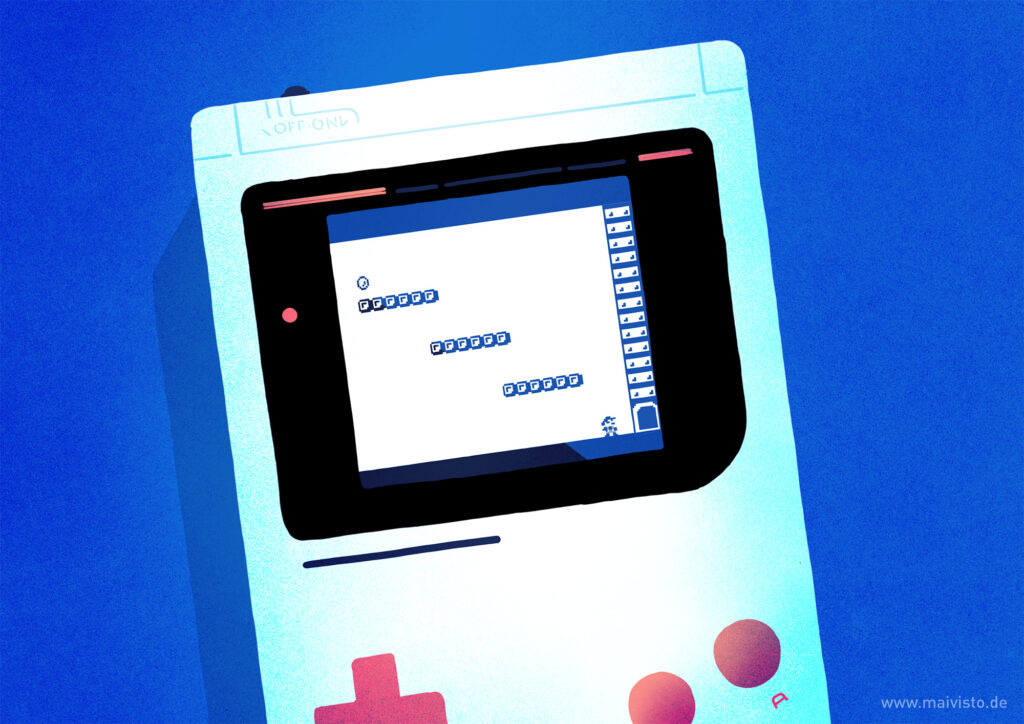
A small change can make much bigger changes happen in the future. That’s the idea behind the butterfly effect. Likewise, a minimal change in our daily routine can have a massive impact on our lives in the long run. The best part is that it doesn’t take much effort to drastically change our lives and achieve our goals. All it takes is some consistency and perseverance.
Continue reading “Building a new routine: the Golden Coin Method”As a creative freelancer, it’s almost impossible to win back clients’ trust once it’s been broken. “This campaign will go through the roof” or “this will be the best illustration you’ve ever seen” is like saying, “I’m the kindest and most generous person.” It’s not up to us to judge such things.
In his book “The Art of Game Design,” Jesse Schell writes about this formula. I read it in my 20s when I was thinking about becoming a game designer. Even though I eventually took a different path, I often think of passages from the book, especially this formula.
Originally it came from the experiential design of roller coasters and thrill rides and is a trademark of Sotto Studios. Horror movies, survival games, and even harmless pranks that scare our friends are based on this simple formula. This brief thrill and adrenaline rush are usually followed by relieved laughter. I think this is because we feel very alive at that moment.
There are always situations that can make us sweat. Even as designers and freelancers, whether it’s before client presentations, harsh criticism of our work, or when we feel that tasks are overwhelming us. In those moments, I try to think of this formula. Despite the external “threat,” we are never at real risk of losing our lives.
It helps me to take things a little easier. Stage fright and the tingling in the stomach before a presentation are exciting emotions. If I can suppress the initial panic and flight instinct, I start to enjoy it. This formula helps me do that because I realize that there is nothing that can really harm me.
Client: “You are the expert. I’m afraid I’m not creative at all.”
A client can tell a programmer, “I don’t know anything about computers, HTML, and website programming.” However, a client cannot say to a designer that he is not creative and that his opinion is not important.
Every person is creative in their activity every day. It’s because everyone searches for solutions every day. In addition, every person also has a sense of visual aesthetics. Even if they do not work in our professional field and struggle to express why they like or dislike something.
As illustrators and designers, let’s involve the client. We may be the established experts in our field, but nothing beats a fresh look at our work to make it better. After all, that’s what it’s all about. We want to create the best possible outcome for the project, the client, us, and the audience.
Some people may be too engaging in the creative process, trusting us too little and constricting our creative freedom. If the reasons are not destructive, there are always solutions to solve this—more on this in another post.
“We give you all the creative freedom.” If this is the client’s briefing, it sounds tempting at first. The client seems to have blind faith in us. After all, we can do and try whatever we want. We have the license to play. But actually, it means that sooner or later, we will inevitably lose control.
A game in which we can do whatever we want, without a clear goal, is not a game. We need guardrails. Basic rules that limit what we do and think. Only then can we focus our thoughts, dig deep, immerse ourselves in the task at hand and become truly creative. Too much freedom can be intimidating, superficial, and counterproductive.
A
So let’s accept the client’s constraints and rules to reach his goal. They are what ignite creativity.