Instant joy vs. earned happiness

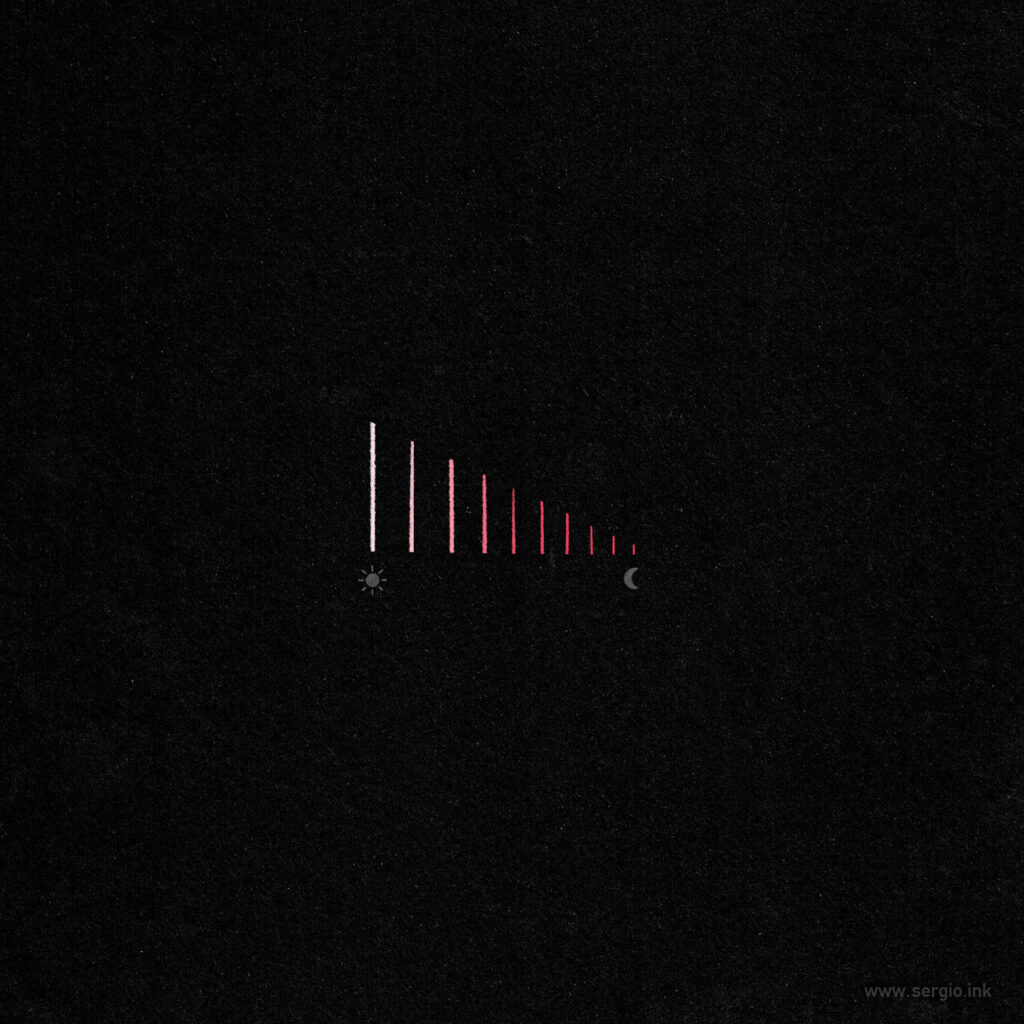
Instant entertainment is just the push of a button away, whether it’s Netflix, YouTube, or Playstation. They all have something in common. They give us immediate joy and fun. We don’t have to do anything to get it except turn on an exciting series or pop in that new game.

Yet, I always notice, especially over the days off between the years: This media is like fast food. The more I consume, the worse I feel afterward. Not necessarily physically, but because I notice how quickly time has flown by. Of course, there’s nothing wrong with a relaxing movie night with friends or my wife. But as soon as I overdo it, entertainment systems turn into pure time thieves.

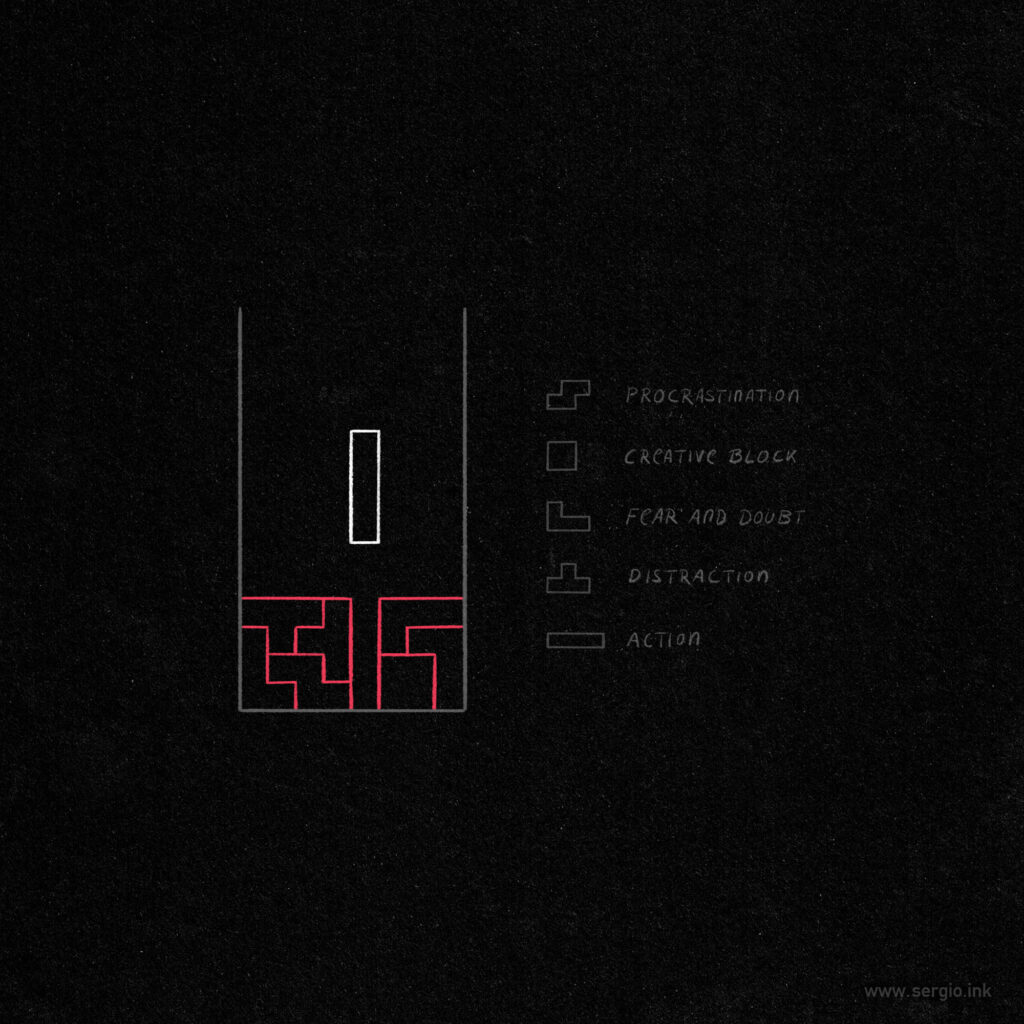
Creative work, on the other hand, feels different. Before starting on a new illustration, whether for clients or myself, resistance always gets in the way first. Sometimes in the form of an annoying little stone in the shoe and sometimes in the form of a massive, fire-breathing monster.

But no matter how big the resistance seems, it vanishes the moment I start. That doesn’t mean that only happiness kicks in from this point on. Frustration and panic are often just as much a part of the creative process as a pleasant and relieving “aha” moment when I’ve conjured up a good idea or a beautiful image composition. Pure joy during creation is rare and comes in waves. However, when one catches us, carries us along, and takes us to new heights, the feeling is almost certainly far more fulfilling than any Instagram reel or video game.

Breaks are boosts

No matter how much we love our work, we sometimes need a little time off to come back even stronger. For example, I love playing soccer but can’t do it for eight hours straight.

Illustrating is my greatest passion. I enjoy drawing every day, yet sometimes, I force myself to take a break for several days or even weeks. Then, I try to do things that have less or nothing to do with drawing. For example, I program and tweak my portfolio website, do the accounting, experiment with my concept for a fictional video game, or write texts like this one.

In my experience, I only realize how good this break actually feels as soon as I take a step back. Let’s consciously switch off our passion now and then so we can recharge. Otherwise, it may suffer from our ambition.

Planning the workday like a hike

When my friends and I plan a hike, we always look for routes with a particular highlight at the end. That can be a great lookout, an abandoned castle ruin, a waterfall, or a restaurant. That is our goal, our reward, and our motivation.

This concept can be applied to the workday. Whenever I have a highlight of the day in mind that I am particularly looking forward to, I work in a more structured way, faster, and am less distracted. That could be my son’s gym class, a soccer game with friends, or a TV evening. Setting a definite highlight is an ideal motivation and productivity booster. Without a daily goal, the workday can quickly drift uncontrollably into the late hours.

When the goalkeeper comes out to catch the ball, he must have it

In football, there is a golden rule: if you, as the goalkeeper, decide to intercept an opponent’s cross, you must catch the ball. If you step out of the goal and underestimate the height, an opponent can easily head it into the empty goal. When this happens, it is a classic goalkeeper’s mistake. For everyone in the stadium, you are to blame, not the teammates, not the coach, not the referee, and not the hole in the pitch that prevented you from making a good jump. You alone made the decision, and you alone misjudged. It’s your fault.

As a freelancer, I often think of my time as a goalkeeper and see similarities. When I accept a client’s job, I must get it done. No one cares if I have a “creative block,” if the kitchen in my apartment is flooded after a burst pipe, or if I catch the flu. If I don’t meet the deadline, the responsibility is all mine.

When negotiating deadlines with our clients, let’s always include a time buffer just in case life has other plans.

All pros start by selling themselves short

As soon as we decide to take money for what we love to do, a new era in our life begins. Often this is the step from a casual hobby, from an amateur to a professional mindset. Suddenly it’s all about delivering, meeting expectations, deadlines, and much more.

The fact that we usually sell ourselves short at the beginning is inevitable. That’s because we misjudge the workload due to lack of experience or endlessly tweak the design out of insecurity before presenting it to the client. Or maybe we’re just happy to make a little money doing what we enjoy the most.

When I decided to go into illustration, I quickly realized that my prices were too low. But at the same time, I realized what I needed to work on to change that. With the increasing quality of my work, an optimized working process, and a focused, sophisticated online portfolio, I would be able to raise prices confidently.

So it’s all about working on ourselves first. The best part is that with the increasing quality of our work and the courage to share it with the world, people will take notice and eventually hire us. And that’s so much more pleasant than knocking door-to-door and making uptight sales pitches.

Let’s be a good boss

As we move into freelancing from permanent employment, many things change in our lives. One fundamental shift is that we no longer have a direct supervisor. We work directly and, usually simultaneously, with several clients. That means that all responsibility lies on us from now on.

At the same time, we enjoy the freedom to work on what, when, where, and how long we want. Unlike permanent employment, we have almost complete decision-making control over our working day and develop unprecedented powers when it comes to maintaining or growing our business.

However, as Stan Lee writes in Spider-Man, “With great power comes great responsibility.” That is true first and foremost for ourselves. We love what we do. Otherwise, we wouldn’t last long through the additional tasks and struggles of self-employment. Besides the actual creative work, we make the acquisition of clients, conduct tough price negotiations, fight existential fears, and do the paperwork for the tax office. Without passion for our profession, our motivation would fade. It is our drive. But this passion can quickly turn into an unhealthy obsession. Overtime, night shifts, and weekend work creep into our daily lives while we neglect physical health.

Let’s take the time we need for ourselves, exercise, take a walk, and spend it with our family. When we make mistakes, let’s not be too hard on ourselves. Let’s allow ourselves a nap when we need it and leave the business cell phone at home when we are on vacation. Let’s be the boss we’d like to work for ourselves.

Seeing without knowing to get great ideas

To be able to orient ourselves in the world, we develop prejudices. Not in a harmful sense. But in order not to lose ourselves in the unfamiliar. We judge a situation based on our previous experiences and decide accordingly. These pre-judgments are like a template through which we see the world.

That’s helpful when visiting another city, learning a new program, or on our first day at a new job. Our experiences give us a sense of security and guidance.

However, this skill gets in our way when it comes to developing ideas. Children are much freer in this respect. We, adults, look at things in a biased way. A coffee mug is for drinking, a chair is for sitting, and a pencil is for drawing. Period. Or maybe there are other options? If you were born in the 80s like me, you know, for example, that there was no better tool for unwinding tangled tapes from audio cassettes than the pencil.

Let’s look at things through a child’s eyes as we search for ideas. Children are unprejudiced. They have no template yet, no bias. They look at objects they encounter from all sides. They twist, turn, play, and try all sorts of things with them. They discover.

Seeing without knowing is something we can learn again. Only when we can break away from our established prejudices do we recognize new connections because new connections are what make ideas original.

Once again, about “less is more”

My post 1+1=0 was about not overloading our work with information. Otherwise, we lose our audience. Be it illustrations, blog posts, or advertisements. In the meantime, two more examples caught my eye.

The movie Terminator 2 was a revelation to my 13-year-old me. It was the only movie in my life where after the credits rolled, I rewound the VHS tape right away to watch it again. I could almost speak the dialogue simultaneously.

One day when I held the DVD in my hands featuring a 17-minute more extended Director’s Cut, I couldn’t wait to watch it. Seventeen more minutes of Terminator! A childhood dream came true.

But the disillusionment was huge. The additional scenes were strange to the point of disappointment. Not only did they seem unnecessary, but they pushed the Terminator character in a different, almost ridiculous direction. Since then, I only watch the original cinema version. Again less was more.

I found another example in D&AD’s The Copy Book. Jim Durfree writes about professional writing:

“When you get your copy to the point where you’re really, really happy with it, cut it by a third.”

Jim Durfree (advertiser, copy writer)

Each illustration deserves a certain amount of individual attention

In my work, creating an illustration usually consists of a rough sketch, a detailed drawing, outlining, coloring, and fine-tuning. When I receive a commission that requires the creation of several, sometimes dozens, illustrations in the same style, I notice the same phenomenon over and over again.

For some illustration steps, such as coloring, I’m on autopilot. By the third illustration, at the latest, it’s like assembly line work. All that’s needed here is my craft and consistency. It doesn’t require a “creative view” or a willingness to experiment. In this phase, I can relax and listen to music, or an episode of King of Queens on the iPad, or talk to friends on the phone.

But at some stage, I always get to the point where that’s no longer enough. It’s a moment when I have to look at the subject closely and match every stroke and detail, whether it’s a portrait, a product, or a scene. I’m sure it sounds corny, but I have to feel it somehow, look at it sensitively. I can’t describe it any other way yet.

I have learned that every work deserves a certain amount of individual attention. Be it just a few strokes or color adjustments. Then it’s music off, smartphone on flight mode, and just feel and react, feel, react, until there is nothing more to discover.

Quick thoughts about the illustration business and storyboarding

The market for illustrators is large and diverse. Books, magazines, movie posters, product packaging, t-shirts, vehicles, and websites are a few areas we can create illustrations for. Agencies can even build multi-million dollar advertising campaigns based on the works of a single illustrator.

Some areas, however, are more saturated. For example, this may apply to children’s books after reading articles and speaking to colleagues. But even that shouldn’t stop us from going all the way in if this is our passion. Apart from that, there are still other areas which we can enjoy.

Children’s book illustrators, for example, could also offer storyboards. They are skilled at freehand drawing and creating entire series of illustrations. They usually can visualize quickly. That skill is necessary for creating storyboards. Storyboards are a daily tool within the creative industry, whether for commercials, game apps, or movies. Speed is essential here. Advertising agencies might call in the morning and ask for a storyboard for a pitch at noon. A fast and reliable illustrator is precious.

PS: Personally, I’m not very comfortable with storyboarding. You can find a little anecdote about this in my last post.

As freelancers having a side hustle is the best we can do. For ourselves, our business, and for our clients

Having a business besides freelancing is the best we can do. For ourselves, our business, and for the clients.

Being a freelancer as an illustrator, web designer, or translator means earning a living with commissions from various clients. Our goal is to generate the commissions that suit us and that appeal to us. We want to develop and improve in our profession and eventually be happy with what we do.

Pursuing a side hustle can be a valuable asset for freelancers in this regard. Having an extra pillar of income can give us the freedom to say No.

At the beginning of my career as an illustrator, I accepted every possible request. On the one hand, I had the time; on the other, I desperately needed the money. So I took a storyboard assignment from a big advertising agency without hesitation. And I did so even though I was aware that freehand drawing was not something I was particularly good at. It was a nightmare. Neither was I fast enough, nor could the quality of my loveless drawings meet the client’s expectations. Nightshift after nightshift, I tried to get the best out of it.

The final result was finally acceptable. But the road to that point was arduous for both parties. It should be clear that the agency has not contacted me again to this day.

Being able to refuse requests is essential for our business, so we can concentrate on offering what we like most (and, therefore, usually do best). But above all, it’s about fairness to the customer. Who wants to hire an unmotivated freelancer who only accepts the job to be able to pay her rent? A well-paying client has the right to the best version of us. Anything else borders on theft.

Good designs are like evergreen songs

A brilliant melody like Ain’t No Sunshine by Bill Withers or a timeless beat like We Will Rock You by Queen doesn’t need any instruments. We can whistle or clap it, and everyone knows the song immediately. On the other hand, a flat or banal melody cannot be saved even by the best orchestra with the most expensive instruments in the world.

It’s the same with design and ideas. A rough sketch of stick figures and speech bubbles on a napkin can visualize an idea for an advertising campaign worth millions. A boring illustration composition, on the other hand, doesn’t become more exciting when we color it in Photoshop. As far as logos are concerned, Kurt Weidemann puts it in a nutshell:

A logo is good when you can scratch it in the sand with your big toe

Kurt Weidemann (typographer, designer).

Before we waste too much time working out an idea or a design, let’s just put in the minimum effort as soon as possible. After that, we can always decide whether to take it a step further or drop it. Just visualizing it in some form usually shows whether it will work.

Let’s hold the urge to spend too much energy on an inquiry before we get a concrete order confirmation

For me, some client requests are particularly exciting. For example, when it comes to soccer-related illustrations, I’d love to get started right away with the first sketches, even before all the conditions are clear.

But despite all the euphoria and confidence about working with a client, we must remember the time and work we invest even before the first brushstroke. Email correspondence or calls alone can sometimes take hours in total. There are questions to answer, joint, binding schedules to set up, and fees to negotiate. Sometimes, there’re additional requests like, “Tomorrow, I’ll present your portfolio to the team. Could you help convince them to work with you by …?”

Carefully clarifying this framework in advance is essential and part of freelancing. However, let’s be sure about what and how much we are willing to invest before reaching an agreement so we don’t waste our and the client’s valuable time.

Feedback is a double-edged sword when generating ideas

On the one hand, criticism and the opinions of others can encourage us. We learn from the experience and mistakes of others. That is precious for our development. How often have professors, fellow students, and clients opened my eyes in despair? Communication is an essential tool for creative work.

On the other hand, the quality of our work is highly dependent on our ability to protect ourselves from external influences and opinions when necessary. For only in silence can we listen to our inner voice.

But each person is different in this respect. Brainstorming in a group, for example, can inspire some people’s creativity. In conversation, they bubble with energy and ideas. For others, however, collective thinking is counterproductive. They need time alone to think about the problem deeply and introspectively.

Figuring out what supports or hinders our creativity is an exciting process. Recognizing our highs and lows, and perhaps even logging them in writing, can bring about fundamental change.